
Power banks have become an essential accessory for travelers, commuters, students, and anyone who relies heavily on smartphones, tablets, or other portable devices throughout the day. With so many options available, one of the most common questions buyers face is how much power bank capacity they actually need.
A larger capacity often means more charging power, but it also usually results in a larger, heavier device. Choosing the right capacity depends on your devices, usage habits, and how frequently you have access to wall outlets.
https://www.amazon.com/power-bank-travel/s?k=power+bank+for+travel
Understanding Power Bank Capacity
Power bank capacity is typically measured in milliamp-hours (mAh). This number indicates how much energy the power bank can store.
In simple terms:
- Higher mAh = More charging capacity
- Lower mAh = Smaller size and lighter weight
However, advertised capacity does not translate directly into charging performance because some energy is lost during the charging process.
For example, a 10,000mAh power bank will not necessarily provide a full 10,000mAh of usable output.
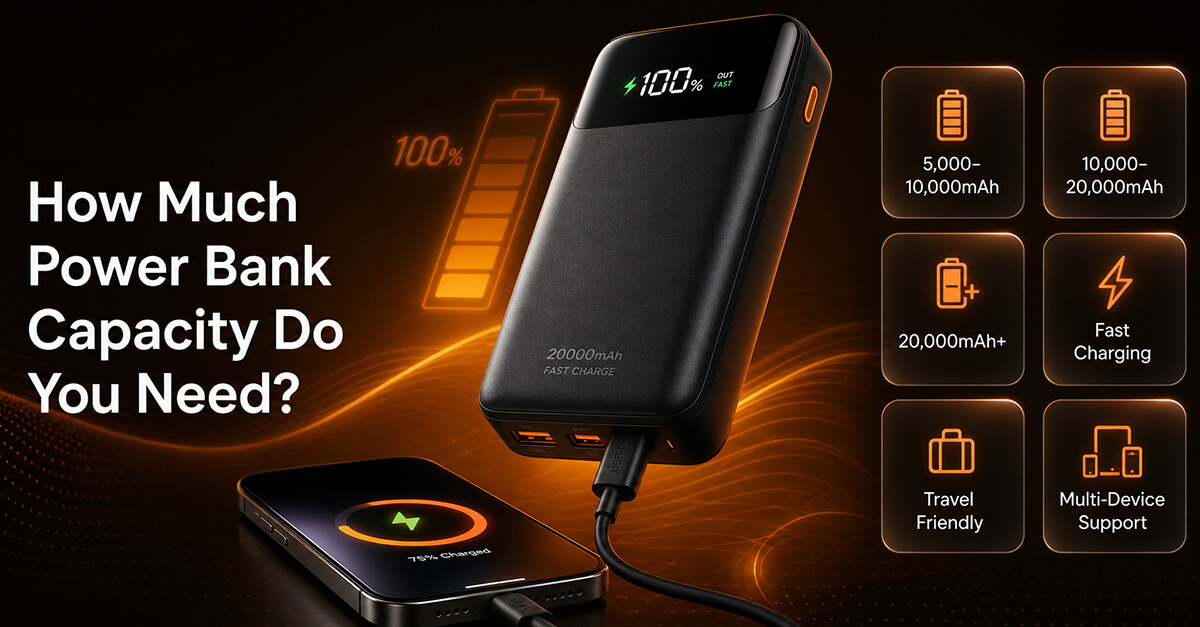
For Occasional Daily Use: 5,000mAh to 10,000mAh
If your goal is simply to keep your smartphone charged during the day, a smaller power bank is often sufficient.
These models are typically:
- Lightweight
- Easy to carry
- Pocket-friendly
- Suitable for daily commuting
A power bank in this range can often provide approximately one to two full smartphone charges, depending on the device.
Best For
- Commuters
- Students
- Casual users
- Everyday backup charging
For Most Users: 10,000mAh to 20,000mAh
This capacity range represents the most versatile option for many buyers.
A 10,000mAh to 20,000mAh power bank generally offers enough capacity to recharge a smartphone multiple times while remaining reasonably portable.
These models provide a good balance between:
- Capacity
- Size
- Weight
- Convenience
Best For
- Frequent travelers
- Remote workers
- Business professionals
- Users with multiple devices
For Extended Travel: 20,000mAh and Above
Larger power banks are designed for situations where access to charging outlets may be limited.
They can often charge:
- Smartphones multiple times
- Tablets
- Wireless earbuds
- Portable gaming devices
Some higher-capacity models can even provide supplemental charging for laptops that support USB-C power delivery.
Best For
- Long trips
- Outdoor activities
- Camping
- Frequent flyers
- Multi-device users
Consider Your Device Types
Capacity requirements vary depending on what you plan to charge.
Smartphones
Most modern smartphones can be charged comfortably with power banks in the 10,000mAh range.
Tablets
Tablets generally require more power and benefit from larger-capacity power banks.
Laptops
Not all power banks support laptop charging. Users should verify both capacity and output specifications before purchasing.
Accessories
Devices such as wireless earbuds, smartwatches, and fitness trackers consume relatively little power and can often be recharged multiple times from a single power bank.
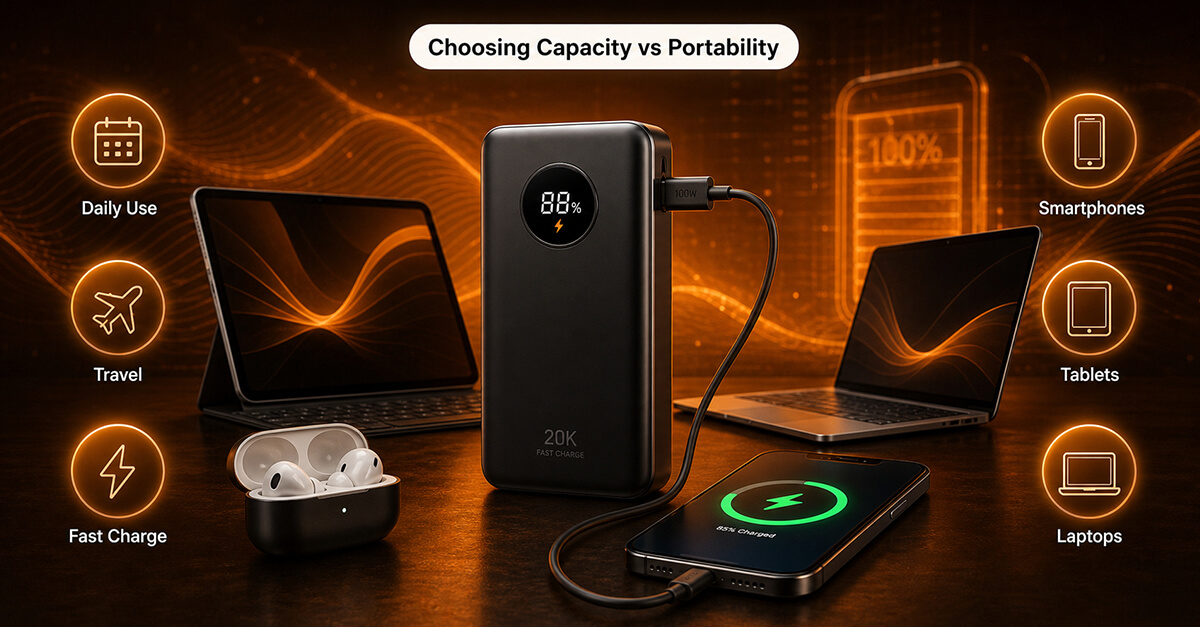
Capacity vs Portability
One of the most important trade-offs is portability.
Higher-capacity power banks generally:
- Weigh more
- Take up more space
- Cost more
Smaller power banks are easier to carry but may require more frequent recharging.
The best choice depends on whether convenience or maximum charging capacity is your priority.
Fast Charging Matters Too
Capacity is only one part of the equation.
Many modern power banks support technologies such as:
- USB-C Power Delivery (PD)
- Quick Charge (QC)
- Fast Charging
These features can significantly reduce charging times and improve overall usability.
A lower-capacity power bank with fast charging may provide a better experience than a larger model with slower output speeds.
Airline Travel Considerations
Travelers should be aware that airlines may impose restrictions on very large battery packs.
Most consumer power banks under commonly accepted airline limits can be carried in hand luggage, but travelers should always verify current airline and aviation regulations before flying.
Common Buying Mistakes
Buying More Capacity Than Necessary
Some buyers purchase the largest power bank available without considering weight and portability.
Ignoring Charging Speed
A high-capacity power bank can still feel slow if it lacks modern fast-charging support.
Overlooking Port Selection
Users with multiple devices may benefit from power banks that include multiple USB outputs and USB-C connectivity.
Focusing Only on Price
Build quality, safety features, and charging efficiency are often just as important as capacity.
Final Thoughts
The ideal power bank capacity depends on how and where you plan to use it. For occasional charging needs, a 5,000mAh to 10,000mAh model is often sufficient. For most users, 10,000mAh to 20,000mAh provides the best balance between portability and performance. Frequent travelers and multi-device users may benefit from capacities above 20,000mAh.
Rather than simply choosing the largest battery available, focus on your typical charging habits, device requirements, and portability preferences. The right balance of capacity, charging speed, and convenience will provide a better long-term experience than capacity alone.